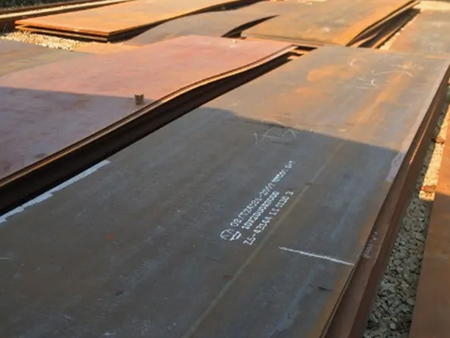
Key points for welding S355K2G2W weathering steel
You’ve specified S355K2G2W for its corrosion resistance and low-temperature toughness. But a poorly welded joint undoes all that. Here’s how to weld it right.
Choose compatible filler metals.
Match the consumable to the base material’s weathering chemistry while maintaining low hydrogen. For most applications:
SMAW: AWS E7018-1 or E7018-G (low-hydrogen, basic-coated). The -1 suffix indicates improved impact toughness at -20°C, matching the K2 requirement.
GMAW: AWS ER70S-6 or ER70S-3 with shielding gas (C25 or Ar/CO₂ mix). Ensure the wire has low hydrogen and good deoxidizers.
FCAW: E71T-1 (gas-shielded) or E71T-8 (self-shielded, low-hydrogen).
Avoid high-hydrogen electrodes like EXX10 or EXX13. They invite hydrogen-induced cold cracking, especially in thick sections.
Control heat input.
Keep heat input between 1.0 and 1.8 kJ/mm for most thicknesses. Measure it:
Heat input (kJ/mm) = (Volts × Amps × 60) / (Travel speed in mm/min × 1000)
Excessive heat coarsens the grain structure in the heat-affected zone and can reduce impact toughness. Use multiple small passes rather than one large, hot pass.
Preheat when needed.
For plates under 12mm at room temperature, preheat isn't mandatory. But when thickness exceeds 15mm, shop temperature drops below 5°C, or moisture is present, preheat to 100–150°C. This drives off hydrogen and slows the cooling rate, reducing crack risk.
Interpass temperature control.
Keep interpass temperature below 250°C, ideally 150–200°C. Let the joint cool between passes if needed. Monitoring interpass temperature is just as important as preheating.
Edge preparation.
Clean the weld zone thoroughly. Remove mill scale, oil, grease, and loose rust. But don’t over-grind the base metal beyond the joint area—the patina chemistry needs to remain intact just outside the weld zone. For plates over 20mm, use a beveled edge (single or double V) for full penetration.
Post-weld treatment.
Let the joint cool in still air. No forced cooling or quenching.
Leave weld reinforcement as-is—the slightly rough surface aids patina formation.
If grinding is necessary for clearance, do it lightly and avoid exposing unweathered base metal.
Never apply paint or sealant over fresh welds unless the design requires it. The weld area needs to weather naturally to form its protective patina.
One critical caution.
S355K2G2W's higher phosphorus content (up to 0.12%) improves corrosion resistance but can make the weld metal more susceptible to hot cracking if heat input is too high. Use low-hydrogen consumables and avoid excessive weaving. If you're welding thick plates or restrained joints, consider a post-weld heat treatment (PWHT) at 550–650°C to relieve stresses—but only if the design allows.